Table Of Content

Randomly dividing the subjects into the 2 groups is the most likely to make the treatment and control groups as alike as possible because it eliminates human bias. Not only differences that the researcher has identified as relevant, but on all characteristics, including the hidden ones that the researcher might not realize are important. The design is balanced having the effect that our usual estimators andsums of squares are “working.” In R, we would use the model formulay ~ Block1 + Block2 + Treat.
An Experimental Treatment Could Help COVID Smell Distortion - Scientific American
An Experimental Treatment Could Help COVID Smell Distortion.
Posted: Fri, 15 Dec 2023 08:00:00 GMT [source]
Example Problem on Randomized Complete Block Design
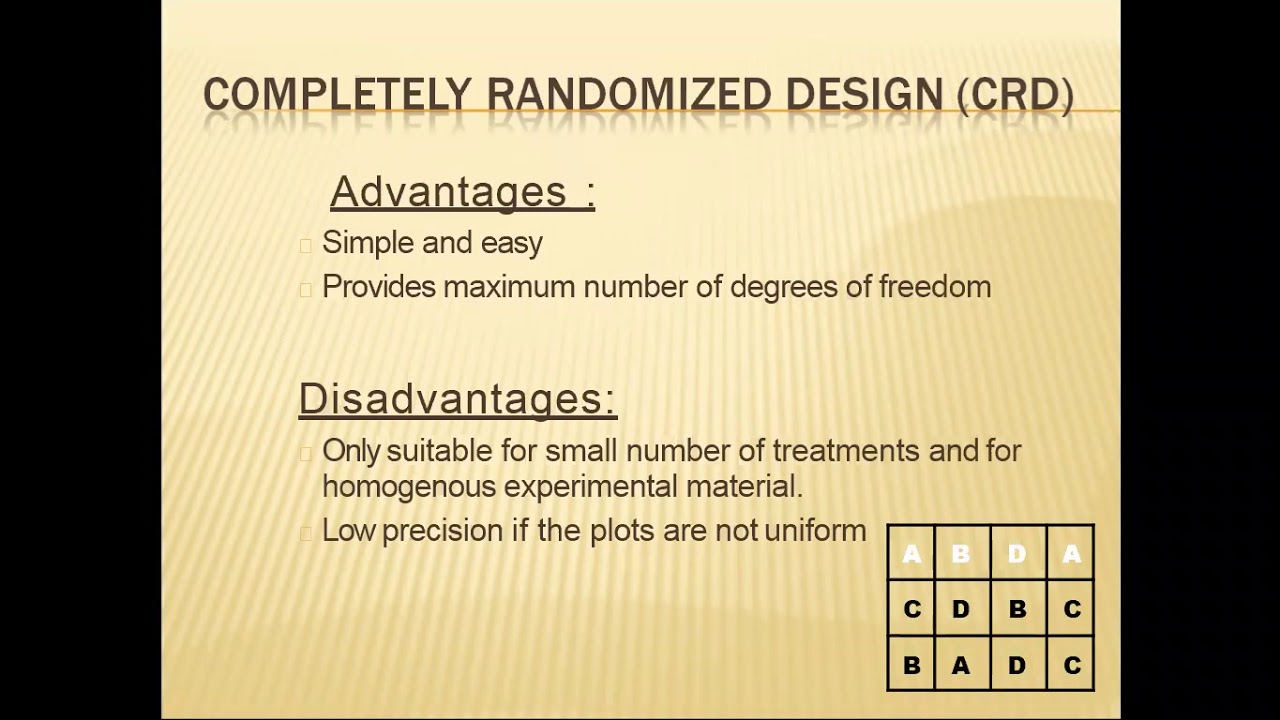
The single design we looked at so far is the completely randomized design (CRD) where we only have a single factor. In the CRD setting we simply randomly assign the treatments to the available experimental units in our experiment. If we choose one of the RCB Design Structures, Temperature effects are completely randomized at the Run level. Recipe is nested within temperature and has a different error structure than temperature, because each dough appears within each run.
Randomized Complete Block Design Analysis Model
A farmer possesses five plots of land where he wishes to cultivate corn. He wants to run an experiment since he has two kinds of corn and two types of fertilizer. Moreover, he knows that his plots are quite heterogeneous regarding sunshine, and therefore a systematic error could arise if sunshine does indeed facilitate corn cultivation. Minitab’s General Linear Command handles random factors appropriately as long as you are careful to select which factors are fixed and which are random. Condition one attempted to recall a list of words that were organized into meaningful categories; condition two attempted to recall the same words, randomly grouped on the page. Although order effects occur for each participant, they balance each other out in the results because they occur equally in both groups.
When to use a randomized block design?
In other words, when the error term is inflated, the percentage of variability explained by the statistical model diminishes. Therefore, the model becomes a less accurate representation of reality. So if you don’t block, you will reduce the statistical power of the study. So, the block to block variability is then absorbed in the variance estimator of the residual. Hence, the power gain of the RCB is a trade-off between the variability that can be explained by the block effect and the loss in DF.
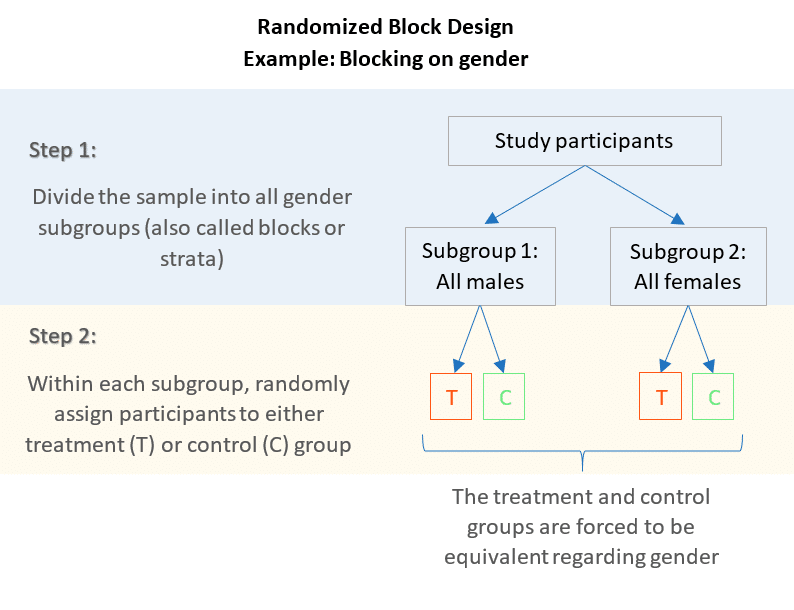
Therefore, it would be very useful to block on gender in order to remove its effect as an alternative explanation of the outcome. And because physical capability differs substantially between males and females, the authors decided to block on gender. So in both experiments we need to do six mass spectrometry runs. We can create a (random) Latin Square design in R for example with thefunction design.lsd of the package agricolae (de Mendiburu 2020). Connect and share knowledge within a single location that is structured and easy to search.
Allocate your observations into treatments
When all treatments appear at least once in each block, we have a completely randomized block design. When we have a single blocking factor available for our experiment we will try to utilize a randomized complete block design (RCBD). We also consider extensions when more than a single blocking factor exists which takes us to Latin Squares and their generalizations.
A non-blocked way to run this experiment would be to run each of the twelve experimental wafers, in random order, one per furnace run. That would increase the experimental error of each resistivity measurement by the run-to-run furnace variability and make it more difficult to study the effects of the different dosages. The blocked way to run this experiment, assuming you can convince manufacturing to let you put four experimental wafers in a furnace run, would be to put four wafers with different dosages in each of three furnace runs. The only randomization would be choosing which of the three wafers with dosage 1 would go into furnace run 1, and similarly for the wafers with dosages 2, 3 and 4. Implementing blocking in experimental design involves a series of steps to effectively control for extraneous variables and enhance the precision of treatment effect estimates. So what types of variables might you need to balance across your treatment groups?
Deposition chamber technology as building blocks for a standardized brain-on-chip framework Microsystems ... - Nature.com
Deposition chamber technology as building blocks for a standardized brain-on-chip framework Microsystems ....
Posted: Mon, 01 Aug 2022 07:00:00 GMT [source]
Blocking is most commonly used when you have at least one nuisance variable. A nuisance variable is an extraneous variable that is known to affect your outcome variable that you cannot otherwise control for in your experiment design. If nuisance variables are not evenly balanced across your treatment groups then it can be difficult to determine whether a difference in the outcome variable across treatment groups is due to the treatment or the nuisance variable. The objective of the randomized block design is to form groups where participants are similar, and therefore can be compared with each other. The term experimental design refers to a plan for assigning experimental units to treatment conditions. Randomly allocating participants to independent variable conditions means that all participants should have an equal chance of taking part in each condition.
2 Power for randomized complete block design
When we can utilize these ideal designs, which have nice simple structure, the analysis is still very simple, and the designs are quite efficient in terms of power and reducing the error variation. A randomized block design is a type of experiment where participants who share certain characteristics are grouped together to form blocks, and then the treatment (or intervention) gets randomly assigned within each block. To address nuisance variables, researchers can employ different methods such as blocking or randomization.
Then, the performance outputs of the proposed FF designs were compared under the same conditions assigned in the previous section. The single-cell performance tests yielded that the highest power density was ensured with nickel foam (NF)-serpentine FF with 0.267 W/cm2. This increment corresponds to a 38 % enhancement in the power output when compared to the classical serpentine-type FF.
You can obtain the 'least squares means' from the estimated parameters from the least squares fit of the model. The sequential sums of squares (Seq SS) for block is not the same as the Adj SS. Variable(s) that have affected the results (DV), apart from the IV. A confounding variable could be an extraneous variable that has not been controlled.


No comments:
Post a Comment